This plan fixes that. It gives you a 90-day roadmap that builds skills step by step while using AI tools to speed up learning, remove confusion, and improve performance.
Table of Contents
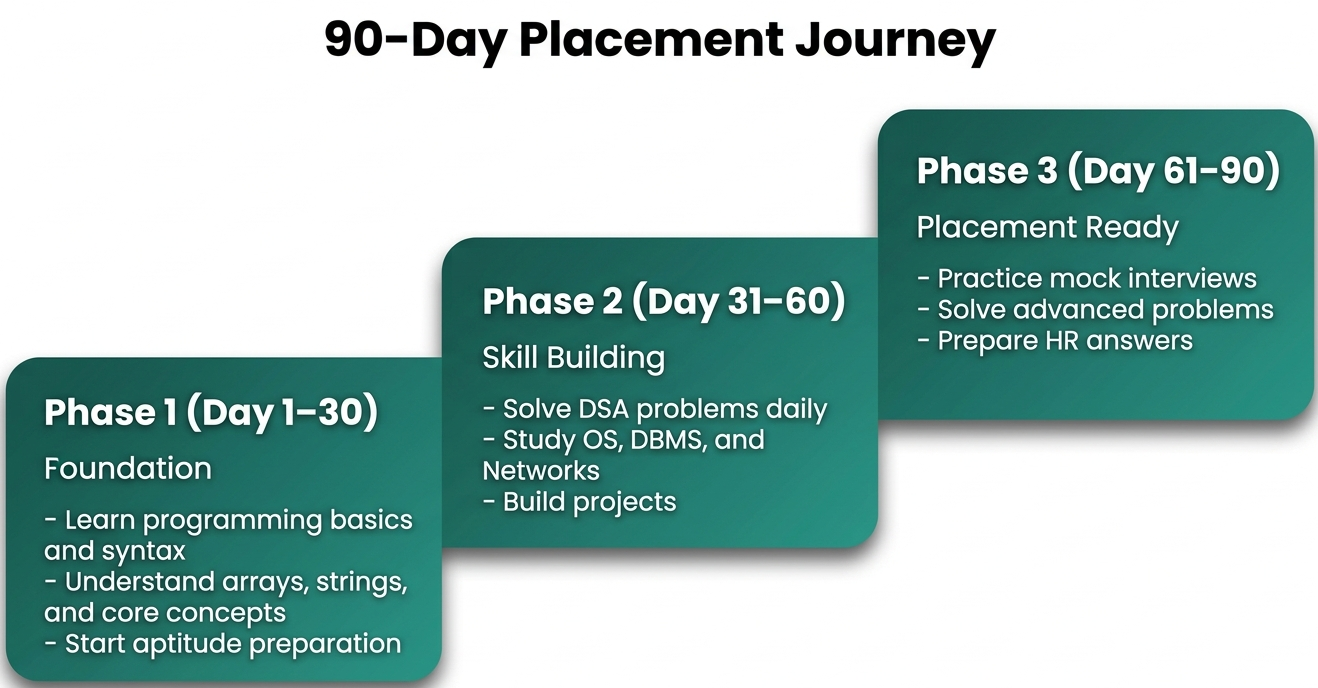
Phase 1 (Day 1–30): Build Strong Foundations
This phase is about getting comfortable with coding and core concepts. You’re not chasing hard problems yet, you’re building confidence.
Programming Basics
- Language selection: Choose one language such as C++, Java, or Python and stick with it to avoid unnecessary confusion.
- Syntax clarity: Focus on loops, conditions, arrays, and functions so that writing basic programs becomes natural.
- Daily coding habit: Practice at least 5–10 simple problems every day to build consistency and speed.
Data Structures Basics
- Array understanding: Learn how arrays work because they are used in almost every coding problem.
- String handling: Practice operations like reversing, searching, and comparing strings.
- Basic structures: Understand stack and queue operations through small examples.
Aptitude Preparation
- Core topics: Cover percentages, ratios, averages, and time-based problems with regular practice.
- Logical reasoning: Solve puzzles and pattern-based questions to improve thinking ability.
- Daily discipline: Spend at least 30 minutes every day on aptitude preparation.
AI Tools for Phase 1
| Purpose | Tool | How to use |
|---|---|---|
| Concept learning | ChatGPT | Use it to explain basic concepts like loops, recursion, or pointers in simple language. |
| Coding assistance | GitHub Copilot | Use it to understand syntax suggestions and reduce small coding errors. |
| Quick research | Perplexity AI | Use it to get concise explanations with references when you are confused. |
Phase 2 (Day 31–60): Problem Solving + Core Subjects
Now the real preparation begins. You shift from understanding concepts to applying them.Data Structures & Algorithms (DSA)
- Sorting techniques: Learn sorting algorithms and understand when to use each one.
- Searching methods: Practice linear and binary search to improve efficiency.
- Problem-solving habit: Solve 2–3 medium-level problems daily to build logic.
Core Subjects
- Operating systems: Learn concepts like processes, threads, and memory management.
- Database management: Practice SQL queries, joins, and normalization.
- Computer networks: Understand how data moves across networks using basic protocols.
Resume Building
- Project focus: Build 1–2 meaningful projects that solve real problems.
- Clear writing: Write project descriptions in simple and clear language.
- Proofreading: Use tools to refine grammar and readability.
AI Tools for Phase 2
| Purpose | Tool | How to use |
|---|---|---|
| Problem hints | ChatGPT | Ask for step-by-step hints instead of full solutions to improve learning. |
| Code explanation | ExplainDev | Use it to understand complex logic in an easier way. |
| SQL practice | SQLBolt | Practice SQL queries interactively to strengthen DBMS concepts. |
| Resume improvement | Grammarly | Use it to make your resume clear, correct, and professional. |
Phase 3 (Day 61–90): Interview Preparation + Mock Practice
This is where preparation turns into performance. You simulate real interview conditions.Mock Interviews
- Practice sessions: Take mock interviews regularly to improve confidence and communication.
- AI-based interviews: Use smart tools to simulate real interview environments.
- Feedback improvement: Analyze your answers and refine them continuously.
Advanced DSA Practice
- Mixed questions: Solve problems that combine multiple concepts to improve thinking depth.
- Time pressure: Practice solving problems within a fixed time limit.
- Revision strategy: Revisit old problems to strengthen retention and confidence.
HR & Behavioral Preparation
- Common questions: Prepare structured answers for frequently asked HR questions.
- Real examples: Use real experiences instead of memorized answers.
- Answer refinement: Improve clarity and tone using AI feedback.
AI Tools for Phase 3
| Purpose | Tool | How to use |
|---|---|---|
| Mock interviews | Interview Warmup by Google | Practice answering questions and get instant feedback. |
| Answer refinement | ChatGPT | Improve your HR answers by making them more natural and structured. |
| Resume scoring | Resume Worded | Analyze your resume and improve ATS compatibility. |
Common Mistakes to Avoid
- Random preparation: Studying topics without a clear plan leads to confusion and wasted effort.
- Passive Learning: Watching tutorials without practicing coding creates false confidence.
- Ignoring Resume: Delaying resume creation reduces your chances during placement season.
- Overdependence on AI: Using AI tools to copy solutions instead of understanding them weakens your skills.
Sample Daily Plan (Day-by-Day Structure)
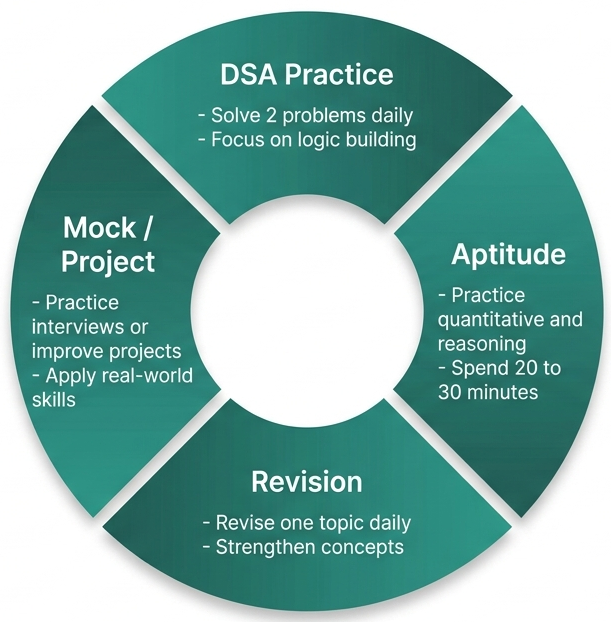
- DSA practice: Solve at least 2 coding problems daily to improve logic and speed.
- Aptitude session: Spend 20–30 minutes solving quantitative and reasoning questions.
- Concept revision: Revise one previously studied topic every day to avoid forgetting.
- Mock or project work: Alternate between interview practice and improving your projects.
Conclusion
What this really means is simple: cracking placements is not about doing everything—it’s about doing the right things consistently.If you follow this 90-day plan with discipline, practice coding daily, revise concepts regularly, and use AI tools smartly, you’ll build both confidence and competence.
You don’t need shortcuts. You need structure, consistency, and honest effort.
Stick to this plan, and by the end of 90 days, you won’t just feel prepared—you’ll actually be ready.
Frequently Asked Questions
1. Can I really crack placements in 90 days?2. How many hours should I study daily?Yes, if you follow a structured plan consistently and practice daily with focus.
3. Which programming language should I choose?You should aim for 4–6 focused hours every day instead of long but unproductive sessions.
4. Are AI tools necessary?You should choose one language and master it instead of switching frequently.
5. What is more important: DSA or projects?They are not mandatory, but they can significantly speed up learning when used correctly.
Both are important because DSA helps you clear interviews while projects showcase your practical skills.

0 Comments