Table of Contents
What is an Assignment Operator?
An assignment operator is used to assign a value to a variable. The most common operator is =. It takes the value from the right-hand side and stores it in the variable on the left-hand side.Example Statement (Basic Assignment):
In this statement, the value 10 is assigned to the variable a.int a;
a = 10;
Types of Assignment Operators in C
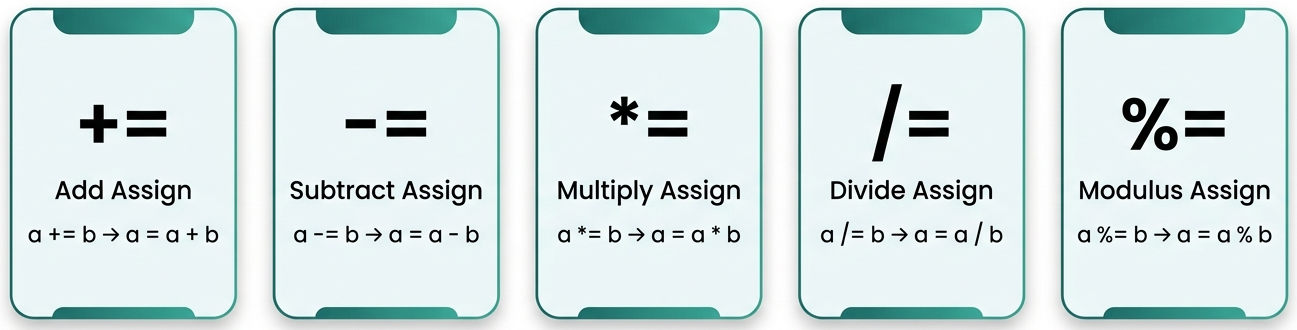
C provides both simple and compound assignment operators. Compound operators combine arithmetic operations with assignment, which helps reduce code length.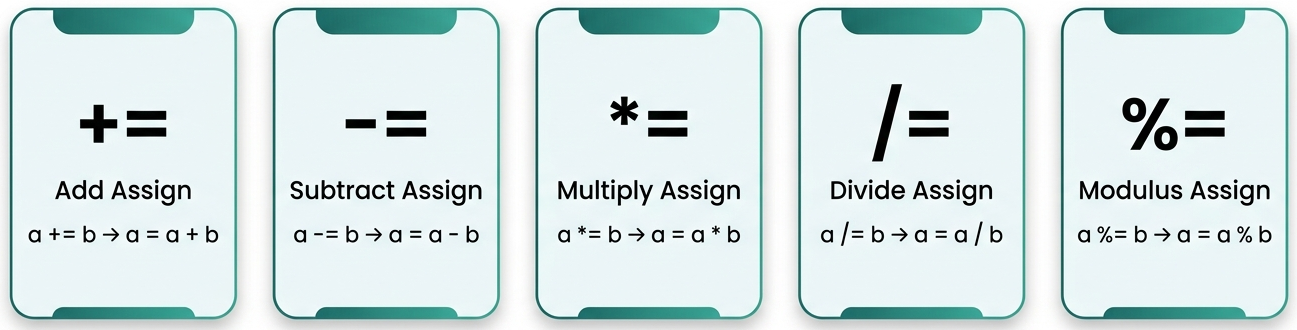
- Simple Assignment (=): This operator assigns the value on the right-hand side directly to the variable on the left-hand side. For example, a = 5; assigns the value 5 to variable a.
- Add Assignment (+=): This operator adds the right-hand value to the variable and stores the result back in the same variable. For example, a += 3; means a = a + 3.
- Subtract Assignment (-=): This operator subtracts the right-hand value from the variable and updates the variable with the result. For example, a -= 2; means a = a - 2.
- Multiply Assignment (*=): This operator multiplies the variable by the right-hand value and stores the result in the same variable. For example, a *= 4; means a = a * 4.
- Divide Assignment (/=): This operator divides the variable by the right-hand value and updates it with the result. For example, a /= 2; means a = a / 2.
- Modulus Assignment (%=): This operator calculates the remainder when the variable is divided by the right-hand value and stores it back in the variable. For example, a %= 3; means a = a % 3.
Example: Basic Assignment Program
Here is a basic C program to show assignment operator:
// C program to show assignment operator
#include stdio.h

// Main function
int main()
{
    int a;
    a = 5;

    printf("Value of a = %d", a);
    return 0;
}
Output;
Value of a = 5
Example: Compound Assignment Operators
Here is an example of compound assignment operator:
// C program to show compound
// assignment operator
#include stdio.h

// Main function
int main()
{
    int a = 10;

    a += 5;
    printf("After += : %d\n", a);

    a -= 3;
    printf("After -= : %d\n", a);

    a *= 2;
    printf("After *= : %d\n", a);

    a /= 4;
    printf("After /= : %d\n", a);

    a %= 3;
    printf("After %%= : %d\n", a);

    return 0;
}
Output:
After += : 15
After -= : 12
After *= : 24
After /= : 6
After %= : 0
How Assignment Works Internally?
Assignment in C does not mean equality; it means storing a value.- Right Side Evaluation: The expression on the right-hand side is evaluated first before assigning it to the variable.
- Value Copying: The value is copied into the variable, so changes to one variable do not affect another.
- Type Conversion: C may automatically convert data types when assigning values between different types.
Example: Multiple Assignments
Here is an example of multiple assignments in C:
// C program to show multiple assignments
#include stdio.h

// Main function
int main()
{
    int a, b, c;

    a = b = c = 10;

    printf("a = %d, b = %d, c = %d", a, b, c);
    return 0;
}
Output:
a = 10, b = 10, c = 10
Important Points
Here are some important points to keep in mind while using assignment operators:- Valid Left Side: The left-hand side must always be a variable and not a constant or expression.
- Code Simplicity: Compound operators help make code shorter and easier to read.
- Execution Order: The right-hand side is always processed before assignment happens.
- Clarity Matters: While chaining assignments is allowed, excessive use can reduce readability.
Common Mistakes to Avoid
Below are some common mistakes while using assignment operators:1. Using = instead of ==: Many programmers accidentally use the assignment operator inside conditions, which assigns a value instead of comparing it.
Example:
2. Using Uninitialized Variables: Assigning or using variables without initializing them first can produce unpredictable results because they may contain garbage values.Writing if (a = 5) will always evaluate as true instead of checking equality.
Example:
Using
without assigning a first is unsafe.int a;
printf("%d", a);
3. Assigning to Constants or Expressions: The left-hand side of an assignment must always be a variable, not a constant or expression.
Example:
4. Ignoring Type Conversion Issues: Assigning a value of one data type to another can lead to unexpected results due to implicit conversion.5 = a;
or
(a + b) = 10;
is invalid in C.
Example:
This will store only 5 and lose the decimal part.int a = 5.7;
5. Chaining Assignments Carelessly: While statements like a = b = c = 0; are valid, overusing chained assignments can reduce readability and make debugging harder in complex programs.
Conclusion
Assignment operators are one of the most fundamental parts of C programming. They allow you to store values, update variables, and write concise code using compound operators.Once you understand how values move from the right-hand side to the left-hand side, everything starts to click. Mastering these operators makes your code cleaner, more readable, and much easier to maintain.
Frequently Asked Questions
1. What is an assignment operator in C?2. What are compound assignment operators?An assignment operator is used to assign a value to a variable, such as using = to store a value.
3. Can we assign multiple variables at once?Compound assignment operators combine arithmetic operations with assignment, such as +=, -=, and *=.
4. Is a += 5 the same as a = a + 5?Yes, you can assign multiple variables in one statement like a = b = c = 5;.
5. What happens if types are different during assignment?Yes, both statements produce the same result.
C performs implicit type conversion, which may sometimes cause data loss.

0 Comments