There are hundreds of topics. Thousands of problems. Too many opinions.
The problem isn’t difficulty. The problem is lack of structure.Some say solve 500 problems.
Some say learn dynamic programming first.
Some say focus only on arrays.
This guide gives you a step-by-step Data Structures and Algorithms roadmap designed for beginners and 3rd year students preparing for placements.
You will learn:
- What to study
- In what order
- For how long
- How many problems to solve
- How to connect DSA with coding interviews
Table of Contents
- Why DSA Is Important for Placements
- Before You Start: Prerequisites
- Step 1 - Understand Time and Space Complexity
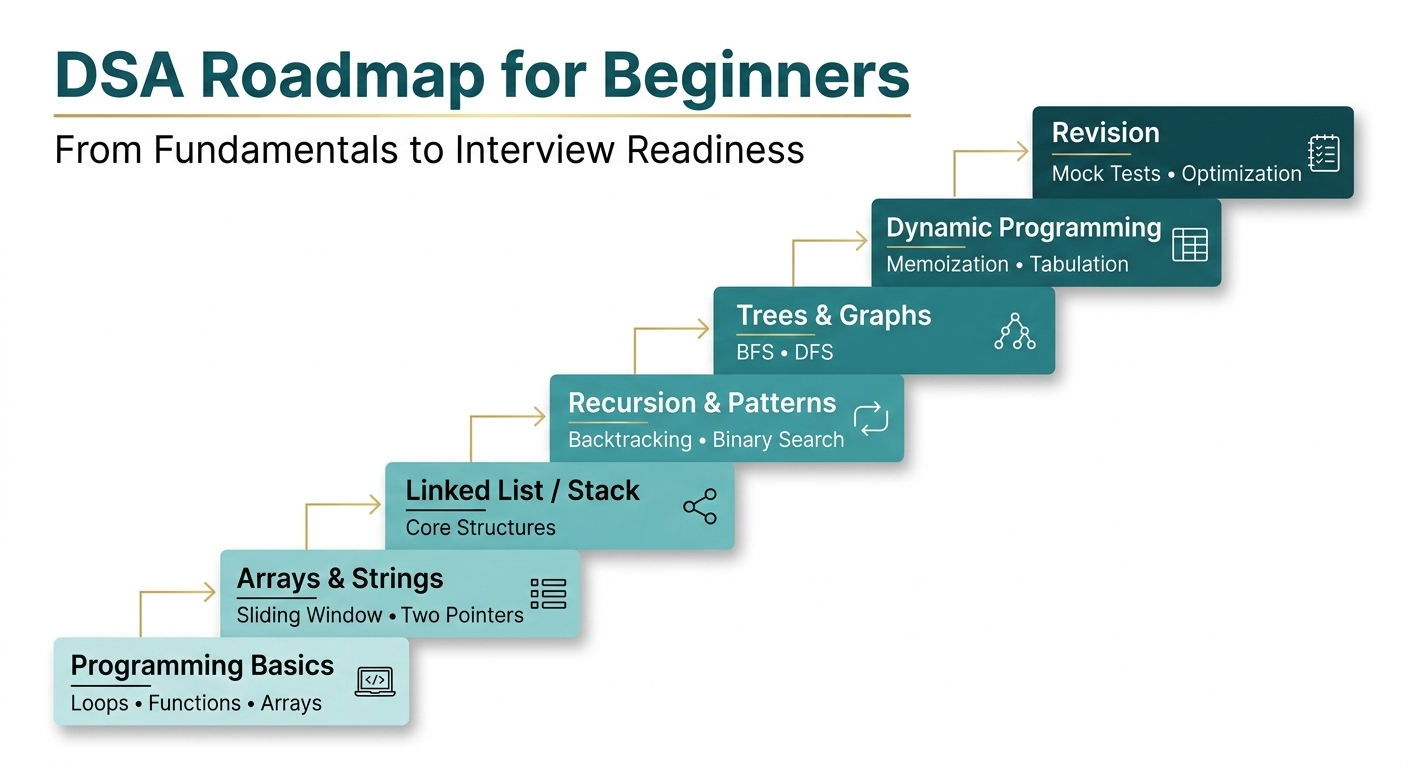
- Step 2 - Arrays and Strings
- Step 3 - Linked List, Stack and Queue
- Step 4 - Recursion and Backtracking
- Step 5 - Hashing and Problem Patterns
- Step 6 - Trees and Graphs
- Step 7 - Basic Dynamic Programming
- How Many Problems Should Beginners Solve?
- A 4-6 Month DSA Study Plan
- Common Mistakes to Avoid
- Frequently Asked Questions
Why DSA Is Important for Placements
Companies use DSA to test:- Logical thinking
- Problem-solving ability
- Optimization skills
- Code clarity
Most placement coding interviews include:
- Array problems
- String manipulation
- Linked list questions
- Tree or graph problems
- Time complexity analysis
Before You Start: Prerequisites
Before learning data structures and algorithms, choose one programming language:- C++
- Java
- Python
You should be comfortable with:
- Variables
- Loops
- Functions
- Basic arrays
- Conditional statements
Step 1 - Understand Time and Space Complexity
Before solving many problems, understand efficiency.Learn:
- What is Big-O notation?
- O(1), O(n), O(n²), O(log n)
- How to analyze loops
- Basic recursion complexity
Step 2 - Arrays and Strings (Foundation Layer)
Arrays and strings form the base of most coding interviews. Focus on:- Traversing arrays
- Two pointer technique
- Sliding window pattern
- Prefix sum
- Sorting basics
- Frequency counting
- Palindrome problems
- Substring logic
- Anagram detection
Step 3 - Linked List, Stack and Queue
Now you move into structured data storage.Linked List
Learn:
- Singly linked list
- Reversal
- Detecting cycle
- Merging lists
Stack and Queue
Learn:
- Stack implementation
- Queue implementation
- Balanced parentheses
- Next greater element
Step 4 - Recursion and Backtracking
Recursion builds deeper logical thinking.Start simple:
- Factorial
- Fibonacci
- Basic recursive traversal
- Subsets
- Permutations
- Combination problems
Step 5 - Hashing and Problem-Solving Patterns
Hashing is powerful. Many complex problems become simple when using hash maps.Learn:
- Frequency arrays
- Hash maps
- Counting problems
- Sliding window
- Binary search variations
- Two pointers
Step 6 - Trees and Graphs
If you are targeting product-based companies, this stage is very important.Trees
Learn:
- Binary tree structure
- Tree traversals (inorder, preorder, postorder)
- Height of tree
- Binary Search Tree basics
Graphs
Learn:
- Graph representation
- BFS
- DFS
- Connected components
Step 7 - Basic Dynamic Programming
Dynamic Programming (DP) is advanced but manageable with practice.Start with:
- Fibonacci using DP
- Climbing stairs
- Basic knapsack
- House robber
Understand the idea of:
- Overlapping subproblems
- Memoization
- Tabulation
How Many Problems Should Beginners Solve?
Quality matters more than numbers.A realistic benchmark:
Divide them into:250-350 well-practiced problems
| Level | Approximate Count |
|---|---|
| Easy | 100 |
| Medium | 150 |
| Hard | 50 |
Do not solve problems blindly.
After solving each problem:
- Understand why the solution works
- Analyze time complexity
- Try rewriting without looking
4-6 Month DSA Study Plan
Here’s a practical beginner timeline.- Month 1: Programming basics + Arrays + Complexity
- Month 2: Strings + Linked List + Stack + Queue
- Month 3: Hashing + Recursion + Pattern problems
- Month 4: Trees + Graph basics
- Month 5: Dynamic Programming + Mixed problems
- Month 6: Revision + Mock coding tests
| Stage | What Should You Do | Problems to Solve | Difficulty Target | Common Mistake |
|---|---|---|---|---|
| Programming Basics | Write small programs daily | 20-30 basic problems | Easy | Jumping to DSA too early |
| Arrays & Strings | Practice patterns repeatedly | 40-50 problems | Easy → Medium | Memorizing instead of understanding patterns |
| Linked List / Stack | Implement from scratch | 25-30 problems | Medium | Ignoring edge cases |
| Recursion & Patterns | Draw recursion trees | 30-40 problems | Medium | Not visualizing stack calls |
| Trees & Graphs | Practice BFS/DFS thoroughly | 40+ problems | Medium → Hard | Avoiding graph questions |
| Dynamic Programming | Start with memoization | 30-35 problems | Medium → Hard | Trying DP before mastering recursion |
| Revision | Timed mock tests weekly | 8-10 full tests | Mixed | Not analyzing mistakes |
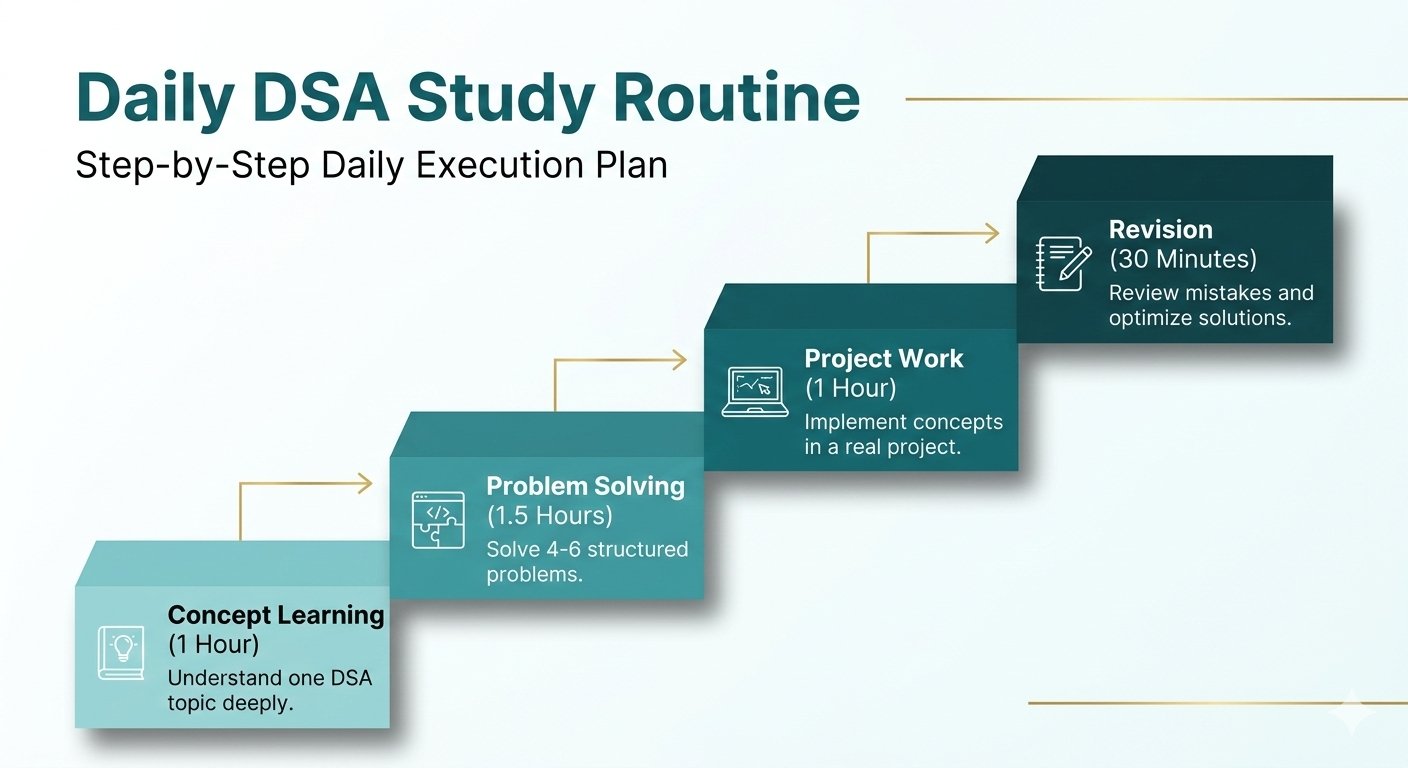
Daily Study Routine
1 hour – Concept learning1.5 hours – Problem solving
30 minutes – Revision
Consistency matters more than long, irregular study sessions.
Common Mistakes to Avoid
Here are some common mistakes:- Jumping to hard problems too early
- Switching programming languages
- Watching too many tutorials
- Not revising old problems
- Ignoring time complexity
Frequently Asked Questions
1. How long does it take to learn DSA for placements?2. Is DSA enough for placements?If you study consistently, 4–6 months is enough for beginner to placement level preparation.
3. Should I learn development before DSA?DSA is essential, but you also need:
- Projects
- Resume preparation
- Interview practice
4. Is Python good for DSA?You can do both, but for placements, DSA should be your priority in early years.
5. How many DSA problems should I solve daily?Yes. Python is beginner-friendly and widely accepted in coding interviews.
Start with 2-3 problems daily. Increase gradually as your speed improves.
Conclusion
Learning DSA is not about solving 1000 problems.It is about:
- Structured learning
- Pattern recognition
- Regular revision
- Calm problem-solving

0 Comments