History and Evolution of Java
Java started in the early 1990s as a small project. Over time, it grew into one of the most popular programming languages.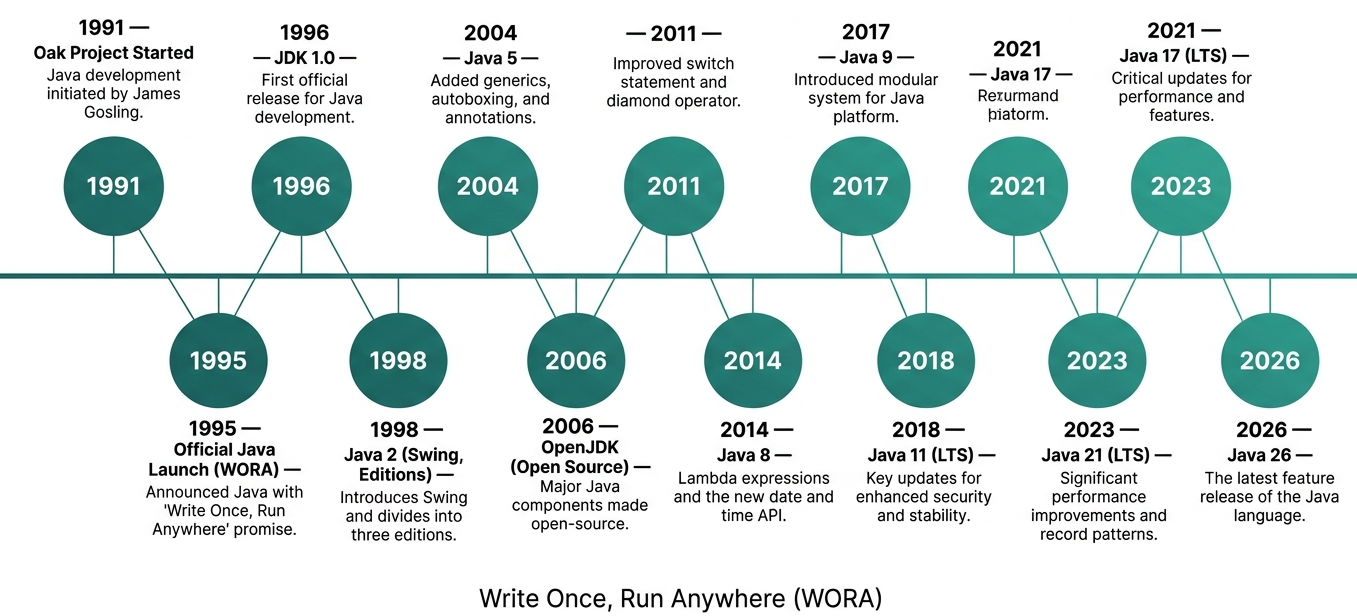
The key milestones in Java's evolution are summarized below in a structured format.
| Year | Version | Short Description |
|---|---|---|
| 1991 | Beginning of Java | Project started at Sun Microsystems by James Gosling as Oak for embedded systems. |
| 1995 | Official Launch | Java released with WORA and Java Virtual Machine for platform independence. |
| 1996 | JDK 1.0 | First official release with basic tools for Java development. |
| 1998 | Java 2 (J2SE 1.2) | This version introduced Swing and split into J2SE, J2EE, J2ME. |
| 2000 | J2SE 1.3 | This version improved performance and stability. |
| 2002 | J2SE 1.4 | Developers added assertions, logging, and XML support. |
| 2004 | Java 5 | Java 5 introduced Generics, Autoboxing, enhanced for-loop. |
| 2006 | Open Source | Java became open source under OpenJDK. |
| 2011 | Java 7 | Java 7 added try-with-resources and improved file handling. |
| 2014 | Java 8 | This version introduced Lambda expressions & Streams API. |
| 2017 | Java 9 | Developers introduced Module System (Project Jigsaw). |
| 2018 | Java 11 (LTS) | Java 11 provided long-term support with better performance & security. |
| 2021 | Java 17 (LTS) | Java 17 focused on improving performance, memory, and modern features. |
| 2023 | Java 21 (LTS) | This version added Virtual Threads & structured concurrency. |
| 2025 | Java 25 (LTS) | Latest stable LTS for enterprise (support till 2028). |
| 2026 | Java 26 | Latest feature release with new enhancements. |
Impact of Java in Modern Programming
- Platform Independence: Java introduced Write Once, Run Anywhere (WORA) using the Java Virtual Machine, allowing programs to run on any system.
- Enterprise Application Development: Java became the backbone of large-scale applications using technologies like Spring Framework and Hibernate.
- Android Development: Java played a key role in mobile app development through Android Studio, making it widely used for Android apps.
- Security and Reliability: Java provides strong security features (bytecode verification, sandboxing) and robust memory management, making it reliable for critical systems.
Conclusion
Java has evolved from a small project called Oak into one of the most powerful and widely used programming languages in the world. Developed by James Gosling at Sun Microsystems, it introduced the revolutionary concept of platform independence. Over the years, continuous updates and features have made Java more secure, efficient, and developer-friendly. Its use in enterprise applications, Android development, and web technologies highlights its versatility. Today, Java continues to grow and remains a key language in modern programming.Frequently Asked Questions (FAQs)
1. Who developed Java?2. What is meant by “Write Once, Run Anywhere” (WORA)?Java was developed by James Gosling and his team at Sun Microsystems in the early 1990s as part of the Green Project.
3. What is the Java Virtual Machine (JVM)?It means that Java programs can be written once and run on any platform without modification, using the Java Virtual Machine.
4. Why was Java considered revolutionary at the time of its launch?The JVM is a runtime environment that executes Java bytecode and enables platform independence by allowing Java programs to run on different operating systems.
5. Is Java still relevant today?Java was revolutionary because it introduced platform independence, strong security features, object-oriented design, and support for internet-based applications.
Yes, Java remains highly relevant today, widely used in web, Android, enterprise, and cloud development due to its strong architecture and continuous updates.
With modern versions like JDK 25 and JDK 26, Java continues to evolve and play a major role in the future of software development.

0 Comments