This guide is not about studying everything. It’s about studying what actually gets you selected.
Table of Contents
What is a Service-Based Company?
A service-based company provides IT services to clients instead of building its own products. You work on projects given by clients, which could involve development, testing, support, or maintenance.Examples of Service-Based Companies

What This Means for You?
- Work Is Project-Based: You may work on different technologies depending on the client’s requirement.
- Training Happens After Selection: Companies expect basic knowledge and then train you further.
- Communication Is Very Important: You need to explain your ideas clearly during teamwork and interviews.
Service-Based vs Product-Based
Here is a clear difference between the two types of companies:| Factor | Service-Based Companies | Product-Based Companies |
|---|---|---|
| Focus | Client projects | Own products |
| Difficulty Level | Moderate | High |
| Coding Requirement | Basic to intermediate | Strong DSA required |
| Interview Style | Structured and predictable | Problem-solving heavy |
Key Preparation Points
- Clarity Over Complexity: You should focus on understanding basics clearly instead of learning advanced topics.
- Consistency Across Rounds: You should aim to perform steadily in all rounds rather than excelling in just one.
What These Companies Actually Test?
Instead of testing deep technical knowledge, they check whether you are trainable and consistent.
| Round Type | What They Check | What You Should Focus On |
|---|---|---|
| Aptitude Test | Speed, accuracy, and basic concepts | Timed practice and pattern recognition |
| Coding Round | Basic logic and correct output | Simple problems with clear thinking |
| Technical Interview | Fundamentals and explanation ability | Concepts + examples |
| HR Interview | Communication and confidence | Prepare structured answers |
Aptitude Preparation (Your First Real Challenge)
Most students get eliminated here because they underestimate it.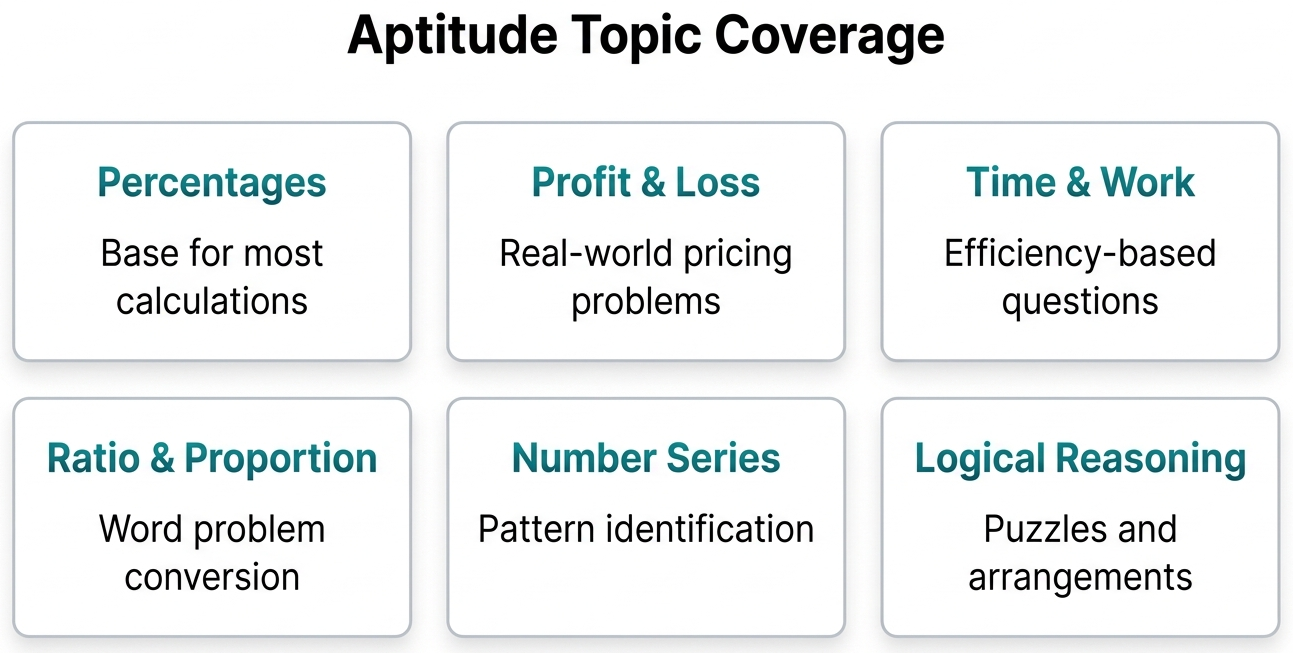
High-Frequency Topics
| Topic | What You Should Be Able To Do |
|---|---|
| Percentages | Convert quickly and solve without lengthy calculations |
| Profit & Loss | Handle real-world scenarios like discounts and margins |
| Time & Work | Solve efficiency-based problems |
| Ratio & Proportion | Translate word problems into equations |
| Logical Reasoning | Solve puzzles and patterns quickly |
Real Exam Attempt Strategy
| Phase | What You Should Do |
|---|---|
| First 10 Minutes | Attempt only easy questions |
| Middle Phase | Solve moderate questions with clear logic |
| Last Phase | Attempt marked questions |
| Final Minutes | Recheck answers instead of solving new ones |
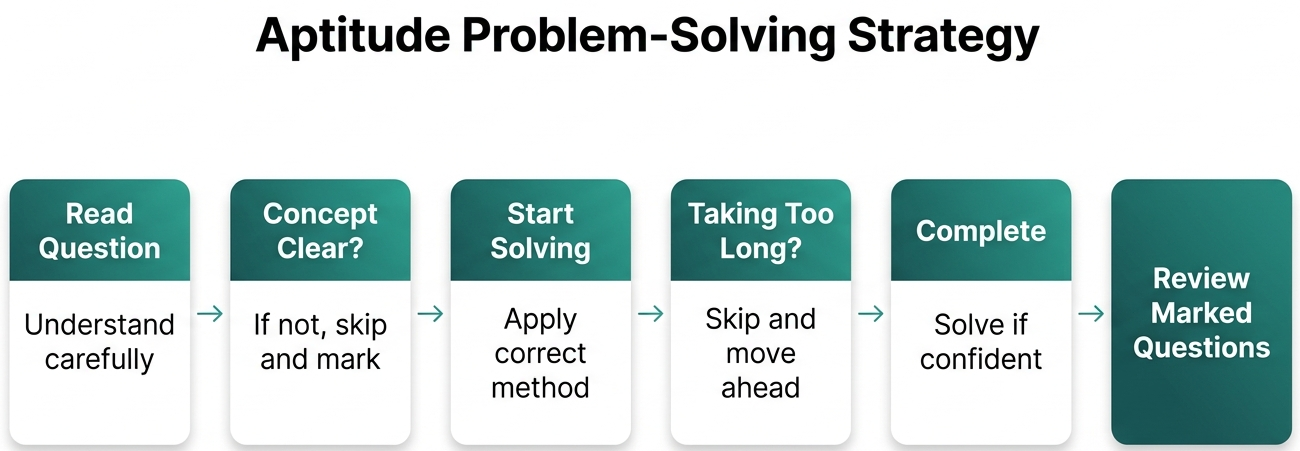
Practical Strategy
- Practice With Time Limit: You should solve questions with a timer to build speed.
- Track Mistakes: You should maintain a notebook of errors and revise it regularly.
- Prioritize Accuracy First: You should aim for correct answers before increasing speed.
Coding Preparation (Focused and Practical)
You don’t need advanced algorithms. You need clear logic and clean execution.| Question Type | What It Looks Like in Test | Difficulty | What You Should Do |
|---|---|---|---|
| Basic Logic | Prime, palindrome, factorial | Easy | Solve without errors |
| Pattern-Based | Star/number patterns | Easy | Practice common types |
| Array Problems | Max/min, reverse | Easy-Medium | Focus on logic clarity |
| String Problems | Reverse string, simple checks | Easy-Medium | Practice edge cases |
| Input Handling | Multiple test cases | Easy | Avoid syntax mistakes |
How to Prepare Coding?
- Solve Without Copying Solutions: You should attempt problems on your own before checking answers.
- Practice Repetition: You should solve important problems multiple times to build confidence.
- Focus on Output: You should ensure your program works correctly for all inputs.
Core Concepts (Only What Is Asked)
You should study only what is relevant for interviews, not everything from textbooks.| Subject | Concept | What You Should Understand Clearly | How to Explain in Interview | Common Questions Asked |
|---|---|---|---|---|
| OOPs | Classes & Objects | You should understand structure and real-world mapping | You should explain using real examples | What is a class and object? |
| OOPs | Inheritance | You should understand reuse of properties | You should explain parent-child relation | What is inheritance? |
| OOPs | Polymorphism | You should understand multiple behaviors | You should explain with examples |
What is polymorphism? |
| DBMS | Primary Key | You should understand uniqueness | You should explain identification of records | What is primary key? |
| DBMS | SQL | You should write basic queries | You should explain logic step-by-step | Write SQL query |
| OS | Process vs Threads | You should understand execution difference | You should explain memory sharing |
Difference between process and thread? |
| CN | HTTP vs HTTPs | You should understand security | You should explain encryption |
Difference between HTTP and HTTPS? |
How to Prepare?
- Practice Speaking Answers: You should explain concepts aloud.
- Use Real Examples: You should connect concepts with practical use.
Resume Strategy (Make It Shortlist-Friendly)
Resume Structure| Section | What You Should Include |
|---|---|
| Projects | Problem + Solution + your role |
| Skills | Only relevant and explainable skills |
| Achievements | Certifications or results |
Before vs After Example
Here is an example showing a comparison between a weak and a strong statement in a resume mentioning the project:
Weak Statement
Strong StatementMade a project using Python
Practical TipsDeveloped a Python-based expense tracker that organizes daily expenses and automates calculations for better tracking
- Keep It One Page: You should make it concise and readable.
- Avoid Generic Content: You should write in your own words.
Interview Preparation
Interviews are less about how much you know and more about how clearly you explain what you know.What Interviewers Check?
| Area | What You Should Do |
|---|---|
| Clarity | You should explain in simple, direct terms |
| Confidence | You should speak calmly and clearly |
| Basics | You should know concepts with examples |
| Honesty | You should admit if you don’t know something |
Simple Answer Framework
You should structure every answer like this:
- Start: Give a direct answer
- Explain: Describe the concept briefly
- Example: Add project or real example
- Close: End confidently
Must-Prepare Questions“I am pursuing B.Tech in Computer Science and have focused on building strong fundamentals in programming and aptitude. I developed a Python-based expense tracker, which helped me understand logic building and input handling. I have been consistently practicing coding and aptitude to improve my accuracy and speed.”
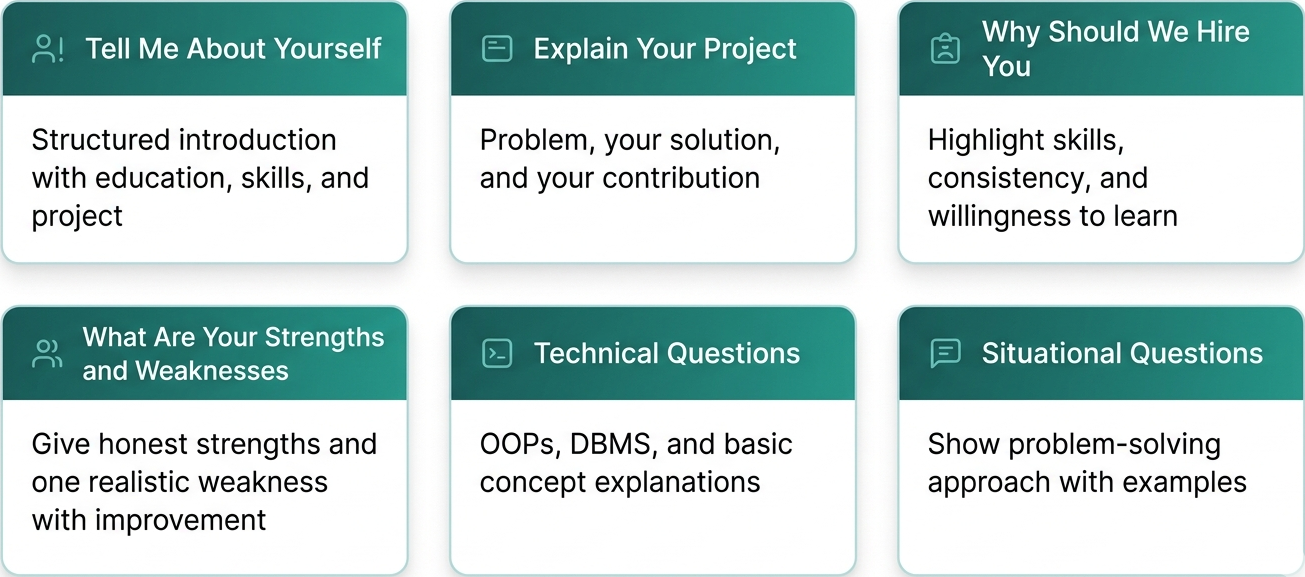
Daily Practice (Important)
- You should practice speaking for 10–15 minutes daily.
- You should explain concepts out loud.
- You should record yourself and improve clarity.
Tools That Actually Help (Use Them Smartly)
| Purpose | Tools You Can Use | How You Should Use Them |
|---|---|---|
| Aptitude Practice | IndiaBix, PrepInsta | Solve timed questions daily |
| Coding Practice | HackerRank, LeetCode | Focus on easy problems |
| Resume Building | Canva, Zety, Novoresume | Create clean resume |
| Mock Interviews | Pramp, InterviewBuddy | Practice before interviews |
| Notes & Revision | Notion, Google Keep | Maintain short notes |
Smart Tool Strategy
- Combine Practice + Revision: You should solve questions and revisit mistakes.
- Avoid Passive Learning: You should focus on solving instead of only watching.
30-Day Plan
Here is a 30-day plan for preparing for an interview for a service-based company: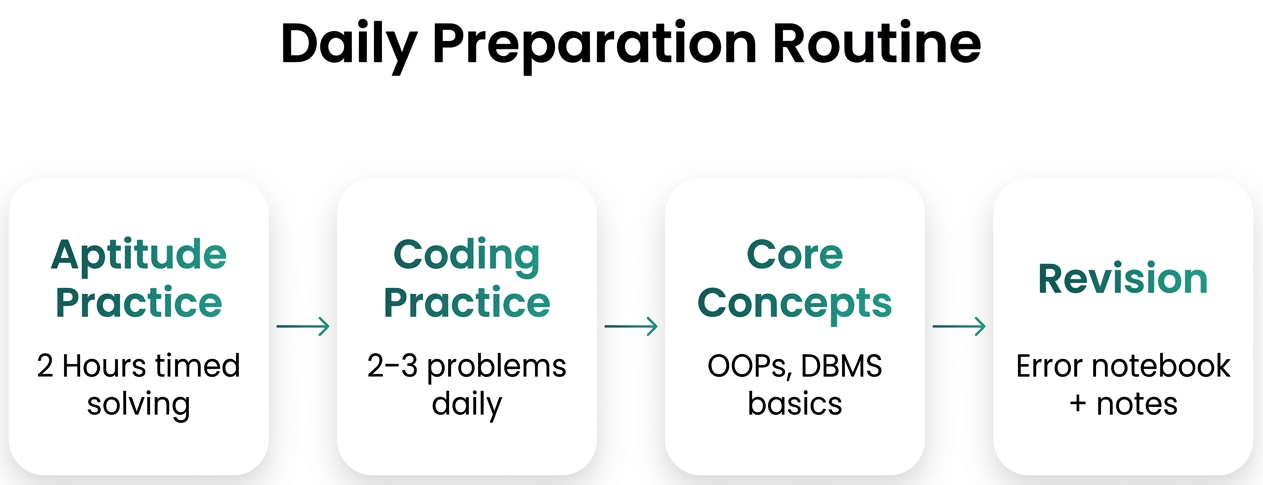
Week 1: Build Foundation
This week's focus is on aptitude basics (percentage, ratio, time & work) and starting basic coding (simple logic problems).| Time Block | What You Should Do |
|---|---|
| 2 Hours | Aptitude basics with timed practice |
| 1 Hour | Coding (basic problems) |
| 45 Minutes | Learn core concepts (OOPs basics) |
| 15 Minutes | Revise mistakes |
Week 2: Improve Speed + Practice
This week focuses on increasing aptitude difficulty and practising coding regularly.| Time Block | What You Should Do |
|---|---|
| 2 Hours | Timed aptitude sets + analysis |
| 1 Hour | Coding (arrays, strings) |
| 45 Minutes | Core subjects (DBMS, OS basics) |
| 15 Minutes | Error revision |
Week 3: Strengthen Concepts + Resume
This week focuses on core subjects, building, and refining resume.| Time Block | What You Should Do |
|---|---|
| 1.5 Hours | Aptitude mixed practice |
| 1 Hour | Coding practice + revision |
| 1 Hour | Core subjects + notes |
| 30 Minutes | Resume building + project explanation practice |
Week 4: Mock Tests + Interview Prep
Week 4 focuses on simulating real tests and practicing interviews.| Time Block | What You Should Do |
|---|---|
| 2 Hours | Full-length mock test or sectional test |
| 1 Hour | Mock analysis + mistake tracking |
| 1 Hour | Interview preparation (HR + technical questions) |
| 30 Minutes | Speaking practice + revision |
Conclusion
Service-based placements are not about doing everything. They are about doing the right things consistently.If you focus on aptitude, practice coding at a basic level, understand core concepts clearly, and improve communication, you can crack these companies confidently. Keep your preparation simple, structured, and consistent. That is what actually works
Frequently Asked Questions
1. Do I need advanced coding?2. Which language should I use?You do not need advanced coding because basic logic is enough.
3. How important is communication?You should use one language consistently.
4. Can I prepare in one month?Communication is very important for interviews.
5. Are projects necessary?You can prepare in one month with consistency.
Projects are important to demonstrate practical knowledge.

0 Comments